
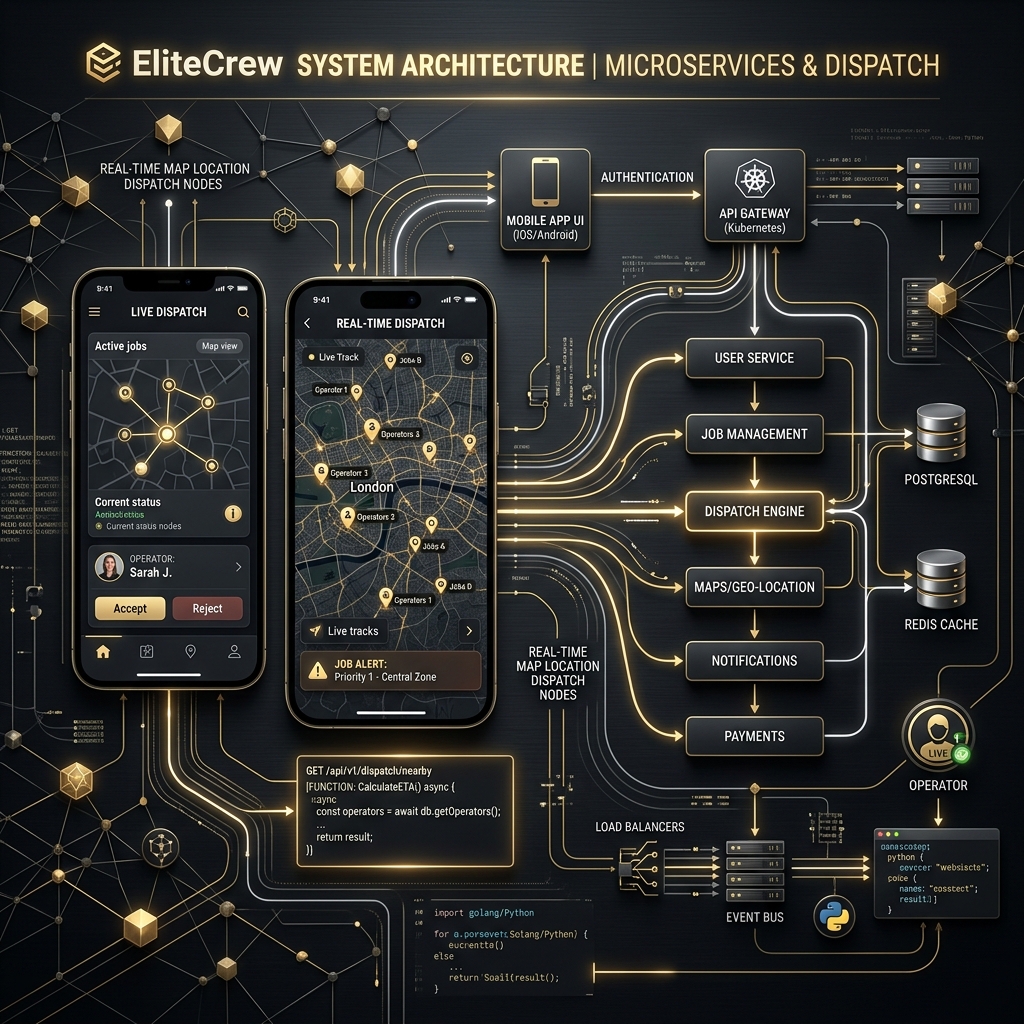
When users open the EliteCrew mobile app or visit [elitecrew.online](https://elitecrew.online), they experience an instant, fluid, and intuitive interface that lets them book a verified professional in under 30 seconds.
Behind that simplicity lies a deeply engineered, production-grade architecture designed and built by Gautam Pandit. In this engineering deep dive, we explore the internal mechanics, algorithmic choices, security guardrails, and real-time state machines that power EliteCrew across 25+ cities.
---
1. High-Level Architecture Overview
EliteCrew is engineered as a decoupled, multi-tier ecosystem comprising: 1. Web Frontend: Next.js 16 (React 19) with Server-Side Rendering (SSR), custom Tailwind CSS design systems, dynamic static generation, and Turbopack. 2. Mobile Apps: Native iOS & Android apps built with React Native & Expo, featuring real-time geolocation tracking and background push alerts. 3. Backend API Gateway: Node.js & Express microservices with rate limiting, Helmet security headers, mongoSanitize protection, and JWT auth state management. 4. Real-Time Dispatch Engine: Socket.io WebSockets for sub-second provider location tracking and active job state synchronization. 5. Data Tier: MongoDB Atlas with GeoJSON spatial indexing, transactional consistency, and fast indexing strategies.
---
2. Deep Dive: Key Engineered Features Inside the Application
Feature 1: The Automated Appliance Diagnoser
One of EliteCrew's standout features inside the application is the Interactive Appliance Diagnoser. Instead of guessing what's wrong with a noisy washing machine or a warm refrigerator, customers answer 3 simple diagnostic steps.
The underlying decision tree algorithm maps symptom vectors to exact potential mechanical faults, recommending the precise service required before a technician even steps foot in the house.